 9800+ TRUSTPILOT REVIEWS


 EN
EN DE
DE FR
FR NL
NL
A dining table is the most-used flat surface in your home. Meals happen on it. So does homework, taxes, board games, laptop work, and most arguments. Buy the wrong one and you live with the wrong one for fifteen years.
Size is what most people get wrong. They measure the room, picture the table, and forget the 90 cm of clearance every chair needs to pull out. Material is the second mistake: marble looks calm in a showroom and stains permanently from a single olive-oil drip at home. Shape is the third: a long rectangle in a square room kills the conversation.
This guide covers the four decisions in order: size for your space, material for your habits, shape for your geometry, and how to match the table to chairs you own or are about to buy. It is built on what 50,000 Furnicher customers across the EU told us worked, and what failed, over the last six years.
The 90 cm rule that makes or breaks the room
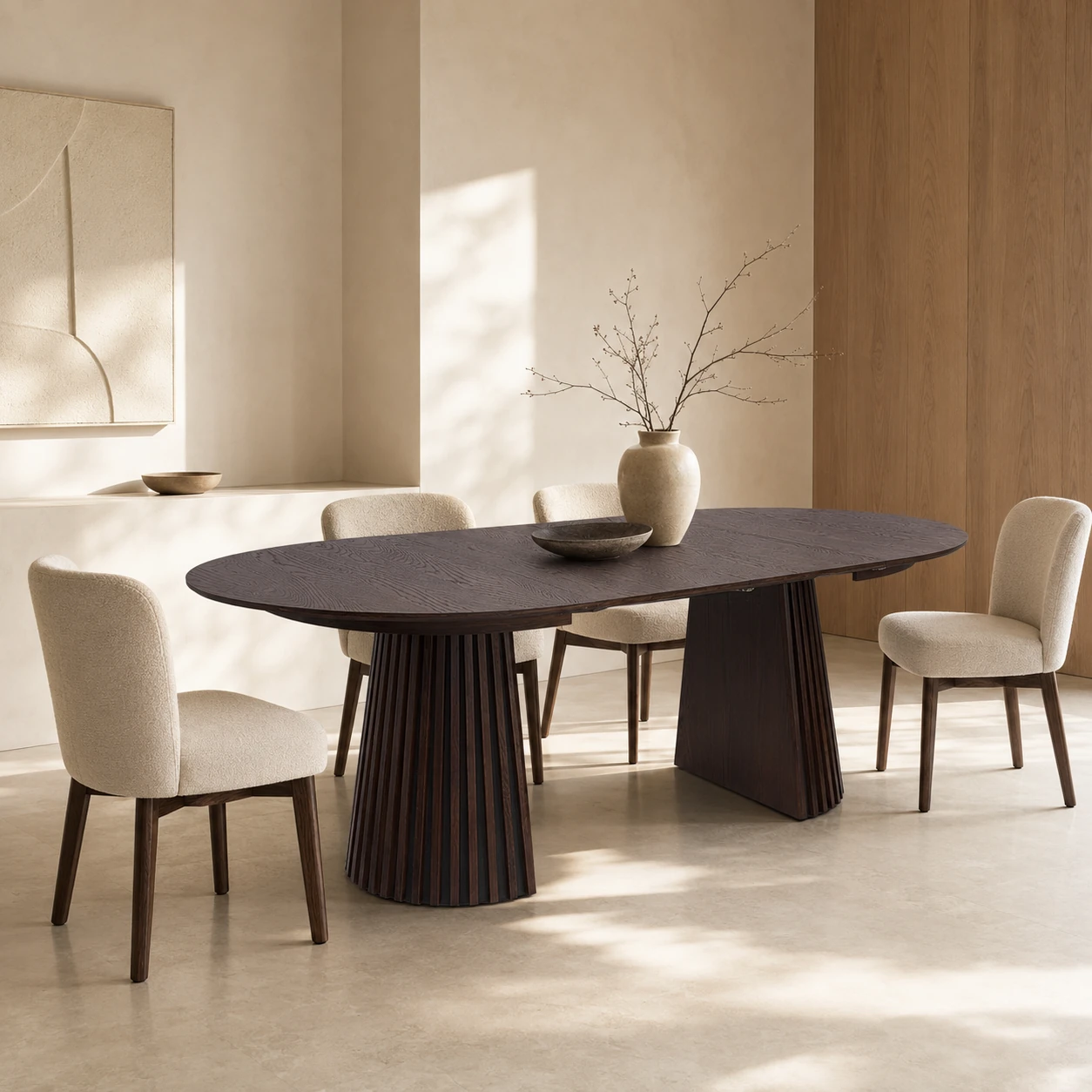
The single most useful number in dining-table sizing has nothing to do with the table. It is the clearance: 90 cm minimum between the edge of the table and the wall, sideboard, or doorway behind it. That is the space a chair needs to pull out and a person needs to slide past someone seated.
Subtract the clearance from your room dimensions before you look at any table. A 4.2 metre room minus 90 cm clearance on each long side leaves 2.4 metres of usable table length. Allow 60 cm of table edge per person and that is six adults across the long sides plus one carver chair at each end. Subtract 30 cm if a sideboard or radiator narrows one side further. Our dining table size guide has the complete configuration chart, and the dining tables for 6 article covers that seat count in detail.
- 90 cm clearance: the minimum on every side a chair pulls out from
- 60 cm of table edge per seated adult: below this and elbows touch
- 120 cm clearance: if a side is also a walking route into the kitchen
- 75 to 78 cm table height: the EU standard, matched to 45 to 48 cm chair seats
The three room shapes that determine your table
Most dining areas in European homes fall into one of three shapes. Each shape changes the right answer about size and form.
The narrow city flat
Berlin Altbau, Parisian Haussmann, Amsterdam canal-house. The dining room shares circulation with the kitchen or living area. Width is the constraint, not length. A 80 cm wide rectangular table at 140 to 160 cm long, or a round 100 to 110 cm table, both seat 4 without blocking the corridor.
Extendable tables earn their price here: 120 cm closed, extending to 180 cm for the once-a-month dinner. Browse our extendable dining tables collection.
The square open-plan dining zone
The dining area sits inside a larger living space and the table reads as a piece of furniture from across the room. A round table 120 to 140 cm in diameter reduces visual bulk and invites conversation. Rectangular works only if the proportion is right; a 180 cm rectangle in a square zone looks parked.
The base style matters more here than in any other room. Pedestal or trestle bases read lighter than four-leg apron tables. Read the round-vs-rectangular guide for a full comparison; for white-finished round tables, the round white dining table guide covers materials and sizing.
The dedicated long dining room
A real dining room, usually rectangular, often Edwardian or Wilhelminian in EU cities. The table is the centre of the room. A 200 to 240 cm rectangular table in solid oak or walnut, with two carver chairs at the heads, makes the space work the way it was originally designed to.
Extendable mechanisms are still useful but less critical: the room can host a 220 cm fixed table without feeling crowded daily.
Featured in this guide


Pick the table to the people, then to the room
The mistake most people make is the other way around. They pick the table to fill the room visually, then squeeze in fewer seats than they actually need. Start with the maximum number of people you regularly seat (not once-a-year occasions; the regular Sunday-lunch reality), then check the table fits the room with proper clearances.
| Table size | Seats comfortably | Max (tight) | Min room size |
|---|---|---|---|
| 120 cm rectangular | 4 | 4 | 9 m² |
| 140 cm rectangular | 4 | 6 | 10 m² |
| 160 cm rectangular | 6 | 6 | 11 m² |
| 180 cm rectangular | 6 to 8 | 8 | 12 m² |
| 200 cm rectangular | 8 | 10 | 14 m² |
| 220 cm rectangular | 8 to 10 | 10 | 16 m² |
| Round 100 cm | 4 | 4 | 8 m² |
| Round 120 cm | 4 to 5 | 6 | 10 m² |
| Round 140 cm | 6 | 8 | 13 m² |
Minimum room size assumes the table sits centred in the room with 90 cm clearance on the long sides. If one side abuts a wall (banquette-style seating), reduce the minimum by roughly 1 to 1.5 m². If both sides are walking routes, add 1 m².
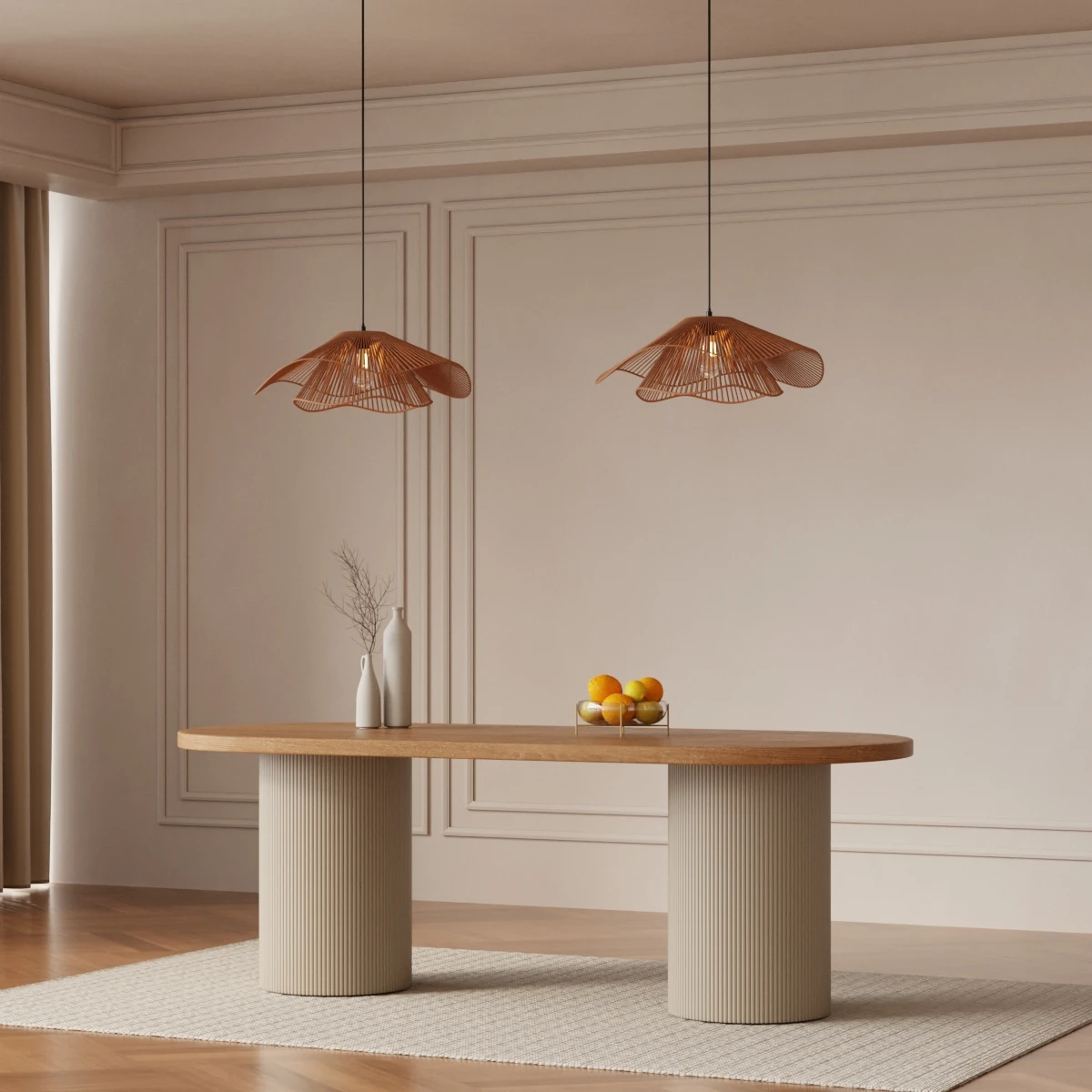
The honest material breakdown
Every material has a failure mode. The question is which failure mode you can live with. Marble etches. Wood scratches. Glass shows every fingerprint. Concrete cracks. Choosing well means matching the material's weakness to a habit you already have.
- Solid oak: 25 to 40 years. Develops dents and ring marks that re-sand cleanly. The honest workhorse for families. Oil every 6 to 12 months if unsealed.
- Solid walnut: 25 to 40 years. Darker grain hides marks; more expensive. Pairs well with cream or muted colour palettes.
- Solid beech: 20 to 30 years. Lighter and harder than oak but tighter grain shows scratches more clearly.
- Carrara or Calacatta marble: outlasts wood but etches from lemon, wine, tomato. Re-honing by a stone specialist costs €200 to €400 per metre. Seal twice a year.
- Tempered glass: 15 to 25 years. Visually weightless; shows every fingerprint. Smoked or fluted glass hides marks better than clear.
- Concrete or zement composite: 15 to 30 years sealed. Develops hairline cracks that read as patina rather than damage. Heavy: 80 to 150 kg, check your floor and lift access.
- Veneered MDF: 8 to 15 years. Looks like solid wood at a third of the price; edges chip if knocked. Cannot be sanded if damaged.
For a deeper look at concrete and zement specifically, read our concrete dining table guide. For marble: etching timescales, sealing routine, and re-honing costs, see our marble dining tables care guide and the wood vs marble comparison.
Round vs rectangular vs oval vs extendable
Shape changes the social dynamic of the table and the geometry of the room. Round tables produce one conversation; rectangular produce two or three parallel conversations and seat more bodies. Oval splits the difference: rectangular capacity with a softer visual line.
Round (up to 6 seats). Everyone faces inward, conversation is natural, no one is at the head. Fits a square room better than a rectangular table of the same seating capacity. Sizes that work: 100 cm (4), 120 cm (5), 140 cm (6).
Rectangular (6 to 12 seats). The workhorse shape for most dining rooms. Long sides seat the bulk of guests; the heads take carver chairs or simply remain empty. Sizes: 160 to 180 cm (6), 200 to 220 cm (8), 240 cm and up (10+).
Oval (6 to 10 seats). Reads softer than rectangular, seats nearly as many, no sharp corners for small children to walk into. Best suited to pedestal or trestle bases rather than four-leg.
Extendable. A practical answer to the small-flat problem: 120 to 140 cm closed, 180 to 220 cm extended. The trade-off is the mechanism. Butterfly leaf systems are the most reliable; cheap cam-lock rails loosen within five years. Read our extendable dining table guide for the mechanism breakdown.
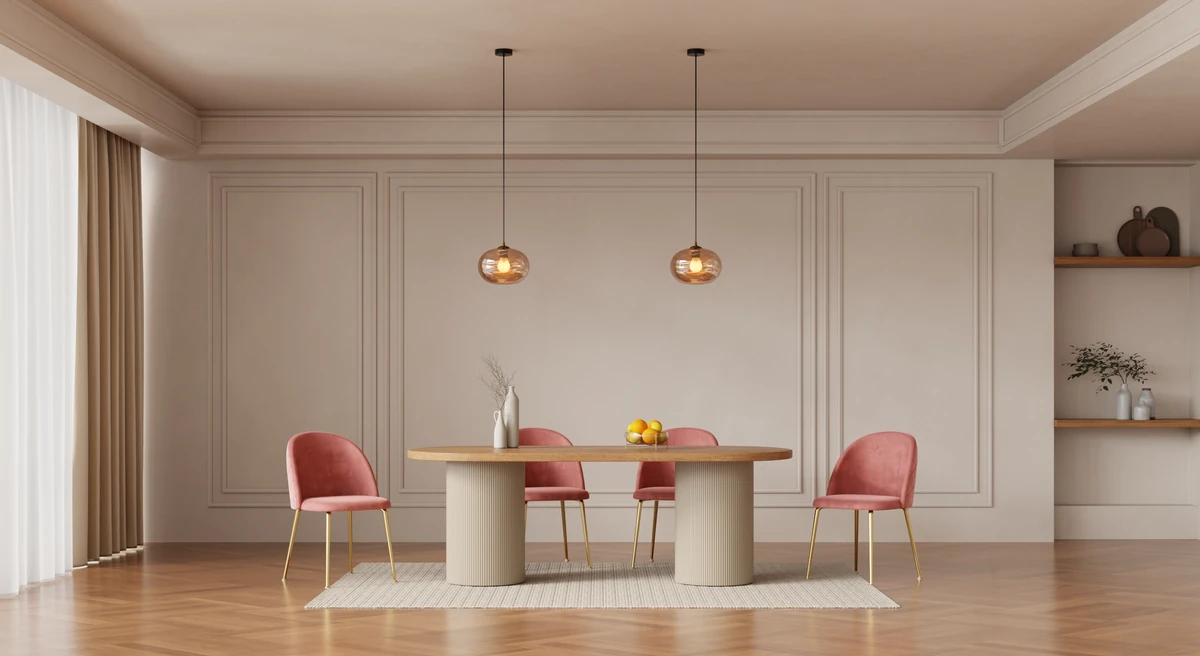
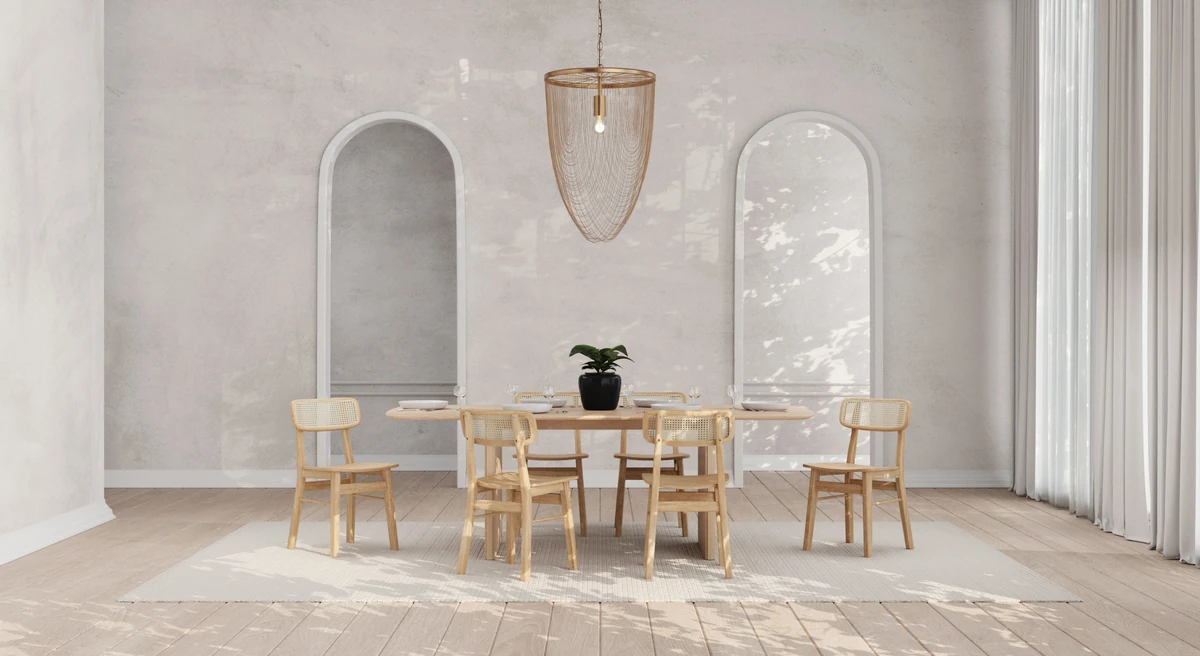
The table is half the decision
Two numbers govern the chair pairing. Seat height to tabletop height: 75 to 78 cm table over 45 to 48 cm seat leaves 29 to 30 cm of thigh-to-underside clearance, which is the minimum for an average-height adult. Get this wrong by 3 cm in either direction and meals become uncomfortable in a way no one quite identifies.
The second is visual weight. A heavy solid-oak table on a four-leg apron base looks wrong with delicate wire chairs; the table wins and the chairs disappear. A glass-top pedestal table loses presence under chunky upholstered chairs. The visible material of the base should rhyme with the chairs, not match exactly. Black-stained ash chairs go with white-oiled oak. Cream bouclé chairs go with Carrara marble. Cane-back chairs go with anything light.
For the full breakdown of chair styles, sizing, and material durability, read the dining chairs buying guide.
Four styles, four very different tables
Style is the last decision, not the first. A table is a 15-year purchase; styles change. Pick the table that reads well today and ages quietly.
Japandi
Defined by what is removed rather than added. White-oiled or natural oak on a clean pedestal base, sometimes black-stained ash for contrast. No apron, no carving, no visible hardware. Pairs with rattan or cane-back chairs.
Read our Japandi dining table guide for sizing and pairing detail. Cross-reference the Japandi interior guide.
Scandinavian
Lighter and warmer than Japandi: more visible grain, sometimes a slight curve in the table edge, tapered leg profiles. Beech and birch also work; walnut reads slightly heavier than the style usually invites.
See the Scandinavian furniture guide for the full style framework.
Industrial
Blackened-steel trestle base under a concrete, zement, or reclaimed-oak top. Suits taller-ceiling rooms and lofts where the table's mass is matched by the space around it. Heavy: budget for a delivery team.
Farmhouse
Wide planks with visible grain, often a lightly brushed or aged surface. The base is a trestle or turned-leg frame in honey oak or warm walnut. Suits large kitchens and open-plan rooms where the table can anchor the space. Pairs naturally with a mix of bench seating and upholstered chairs. The forgiving surface texture hides daily wear better than a flat lacquer finish.
Four habits that double the life of any dining table
Most dining-table damage is preventable. These four habits address the failure points across every material we sell.
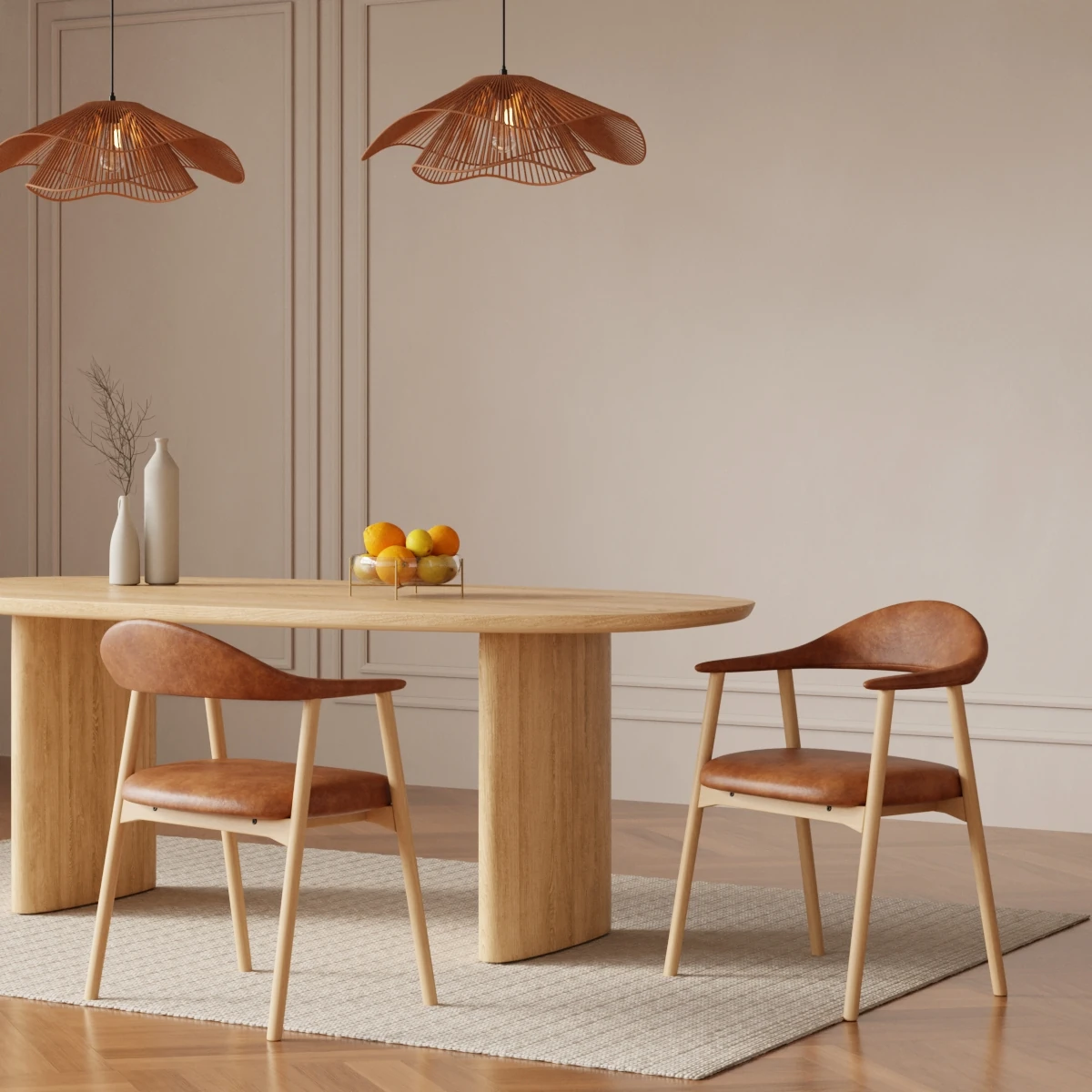
Over 50,000 customers have chosen their table here
Solid oak, walnut, marble, glass, concrete: the full range with honest specs and room-checked dimensions on every product page.
Every dining table at Furnicher comes with the dimensions you need to check it against your room before ordering. Free delivery and free returns across the EU. Klarna available if you want to split the payment.
Browse all dining tables at Furnicher. For smaller cafe-style tables and bistro pieces, read our cafe table design guide.
Dining table questions, answered.
What size dining table do I need?
Allow 60 cm of table edge per person and at least 90 cm of clearance around the table for chairs to pull out and people to walk past. A 140 cm rectangular table seats 4 comfortably. A 180 cm table seats 6. A 200 to 220 cm table seats 8. For round tables, 110 to 120 cm diameter seats 4 and 140 cm seats 6 with conversation flowing across the table.
What is the standard dining table height?
Standard European dining table height is 75 to 78 cm. This pairs with dining chairs that have a seat height of 45 to 48 cm, leaving 29 to 30 cm of clearance between the seat and the table underside. Counter-height tables run 90 to 95 cm tall and require taller stools, usually 60 to 65 cm seat height.
Round or rectangular dining table: which is better?
Round tables seat fewer people in the same diameter but read smaller and conversation flows naturally because everyone faces inward. Rectangular tables seat more, suit longer rooms, and accept end carver chairs at the heads. Round works best up to six seats; rectangular makes sense from six upwards. In a small square room, a round table almost always wins.
Is an extendable dining table worth it?
An extendable table is worth it when you regularly entertain larger groups but live with the smaller footprint daily. The trade-off is mechanism reliability. Butterfly-leaf and pull-out systems on solid-wood tables hold up for 15 to 25 years; cheap MDF leaves with cam-lock rails often loosen within five years. Test the mechanism in the shop or read product reviews carefully before ordering.
What is the most durable dining table material?
Solid oak and beech are the most durable. A well-made solid-wood table lasts 25 to 40 years and can be re-sanded if the surface marks. Marble lasts longer than oak but is heavier and more vulnerable to etching from acidic spills. Glass is durable but shows every fingerprint. Concrete is durable but porous unless sealed and develops hairline cracks over time that some buyers welcome as patina.
How do I match dining chairs to my table?
Match seat height to table height first: 45 to 48 cm seats pair with 75 to 78 cm tables. Match visual weight second: a chunky farmhouse table looks wrong with delicate wire chairs, and a glass table loses presence under heavy upholstered chairs. Match material families third: oak chairs with oak tables, mixed metal with marble or glass, rattan-seat chairs with light Japandi tables.
How do I care for a wooden dining table?
Wipe spills immediately, especially red wine and oil. Oil unsealed solid wood every 6 to 12 months with a furniture oil suitable for that species. Use coasters under hot pans and trivets under serving dishes. Light surface marks on solid wood can be sanded out with 240-grit paper and re-oiled. Sealed and lacquered tops need less oiling but cannot be sanded.
What dining table fits a small dining room?
For rooms under 12 square metres, a round table 100 to 110 cm in diameter or a rectangular extendable table at 120 cm closed (extending to 160 to 180 cm) keeps daily circulation clear and still seats four. Round tables visually reduce the bulk of the furniture; light-coloured tops add to the sense of space. Pedestal bases read lighter than four-leg apron tables.
