 9800+ TRUSTPILOT REVIEWS


 EN
EN DE
DE FR
FR NL
NL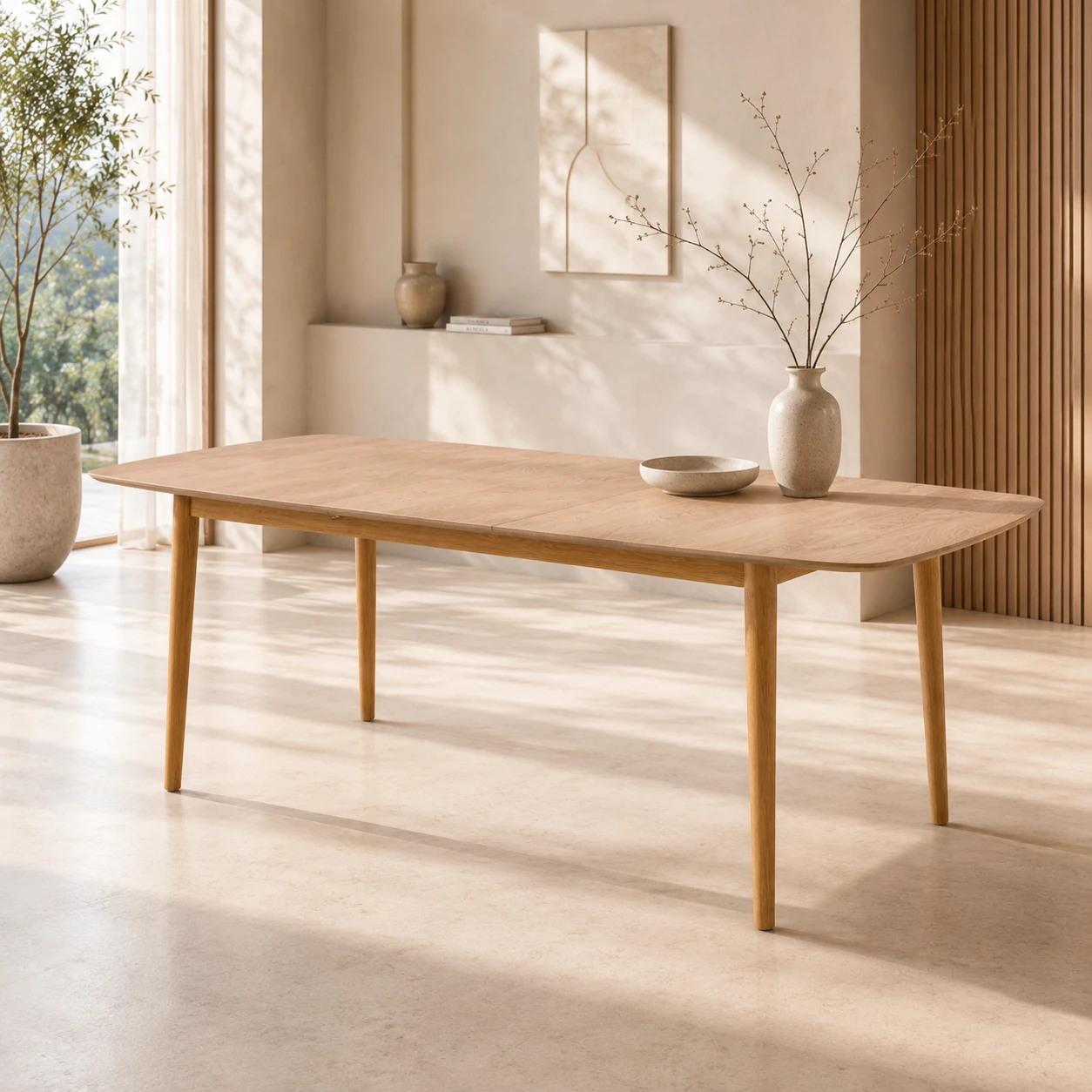
An extendable dining table is a bet: that you will manage with less space day-to-day, but that you are willing to spend 30 seconds about twelve times a year to extend the table for guests. If the bet pays off, you save one-sixth of your dining-room floor area. If it does not, you live with a table whose mechanism sticks and whose centre seam stays visible.
This guide covers when the bet pays off, which mechanism survives 25 years of daily open-and-close, and where manufacturers cut corners on cheap models so the table sits crooked after four years. With concrete recommendations from the Furnicher range.
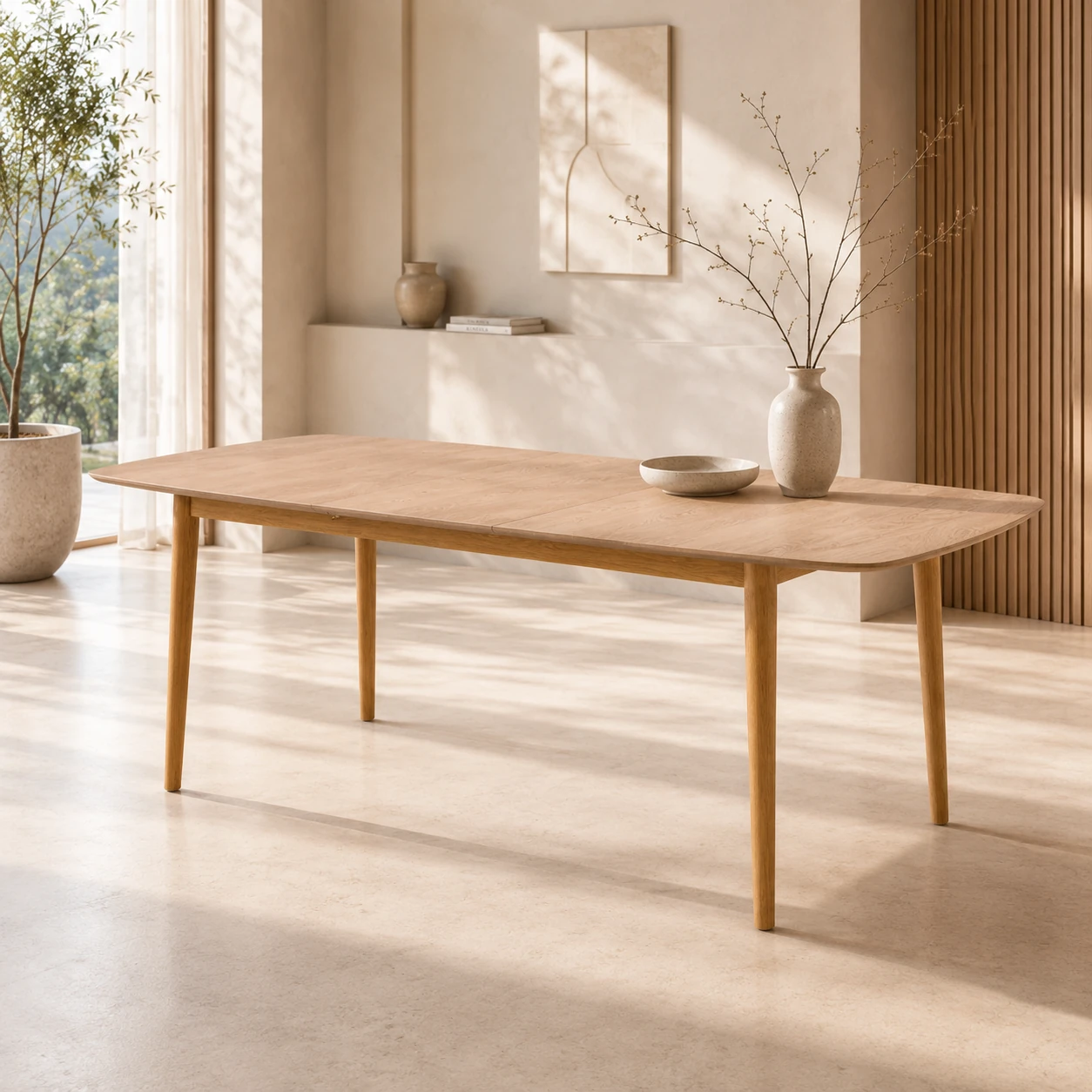
When the extendable is actually the right call
Three criteria settle the question.
- Daily: 2 to 4 people, regularly: the table sits closed in daily mode. If you already seat six or more every day, you do not need an extendable; you need a larger fixed table.
- Guests: 3 to 12 times a year for 6 to 10 people: the right frequency for an extendable. Weekly extension is frustrating with most mechanisms. Never extending means paying for a mechanism you do not use.
- Room: tight but not extreme: a 10 to 14 m² dining area with 4.5 m of length fits a 140 cm table that extends to 200 cm seating eight. Smaller rooms fail the 90 cm clearance rule when extended.
More on room sizing in the dining tables buying guide.
Three extension mechanisms compared honestly
The mechanism decides whether the table still closes cleanly after 5 years or becomes a daily frustration.
Butterfly leaf
The middle leaf unfolds from inside the tabletop and expands the surface. No separate leaf to store. Available at Furnicher in solid oak and solid walnut, €999 to €1,200. Best stability, cleanest look extended, lasts 15 to 25 years.
Synchronised pull-out
Both halves of the table pull apart in sync; an additional leaf drops into the gap. €699 to €899. Functions reliably 10 to 15 years. Drawback: the separate leaf must be stored, usually in a cupboard or under the bed.
Simple drop-leaf
The table ends fold up or out. From €449. Works for occasional use 4 to 7 years. The hinges and clamp rails are the weak points: they loosen over time, the table wobbles when extended.
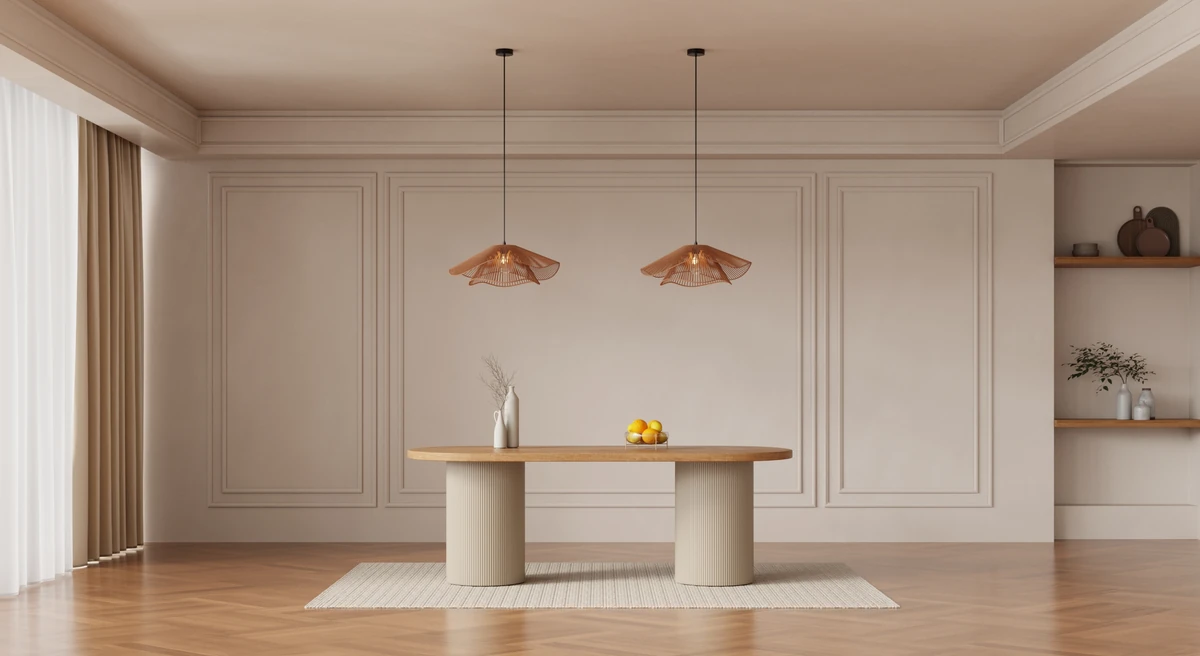
Featured in this guide


Which size for which occasion actually
The most popular sizes in the Furnicher range. Second column shows extended length, third shows seat count extended.
| Closed | Extended | Seats max | Room from |
|---|---|---|---|
| 120 cm | 180 cm | 6 | 10 m² |
| 140 cm | 200 cm | 8 | 12 m² |
| 160 cm | 220 cm | 8 to 10 | 14 m² |
| 180 cm | 240 cm | 10 | 16 m² |
| 200 cm | 280 cm | 12 | 18 m² |
Golden middle for most four-person families: 140 to 200 cm. Daily 4 in comfort, extended 8 for Christmas or birthdays. Minimum room sizes apply to the extended state with 90 cm clearance.
Also worth a look: the Japandi dining table guide if you want an extendable with a clear style direction.
What fails on cheap extendable tables
Anyone buying an extendable under €449 should know where the cost-cutting happens. Four typical weak points.
Plastic clamp rails: the most common failure. Plastic guides lose clamping pressure over time. The table still opens, but the centre seam becomes visible or the two halves sit at slightly different heights. Steel rails last roughly twice as long.
MDF leaf inserts: warp at the edges, because MDF reacts to humidity. After 3 to 5 years the leaf sits 1 to 2 mm higher or lower than the rest of the tabletop. Solid wood or thicker veneer handles this better.
Wooden dowels instead of metal connectors: the join between table halves and base. Pure wooden dowels develop micro-gaps over the years; the table wobbles even in the closed state.
Screwed instead of mortise-and-tenon legs: wood screws in solid timber loosen under load over years. Mortised legs last two or three table generations.
Find the right extendable for your space
Drop-leaf from €449, synchronised pull-out €699 to €899, butterfly leaf €999 to €1,200.
Every extendable at Furnicher comes with mechanism specs and solid/veneer detail on the product page. Free delivery and free returns across the EU. Klarna available.
Browse extendable dining tables at Furnicher. For full context: dining tables buying guide.
Quick answers.
When is an extendable dining table worth it?
An extendable table is worth it when you regularly seat 4 or fewer but host 6 to 10 people 3 to 8 times a year. Those who extend weekly should choose a larger fixed table. Those who never extend pay for the mechanism without using it.
Which extension mechanism is best?
Butterfly leaves in solid wood last 15 to 25 years and sit flush within the tabletop. Synchronised pull-out mechanisms with steel rails are second best. Avoid simple drop-leaf or fold-out systems with plastic clamp rails in MDF, which usually loosen within 4 to 6 years.
What fails on cheap extendable tables?
Four typical weak points: plastic clamp rails lose grip and the extension jams or sits crooked. MDF inserts warp at the edges. Wooden dowels crack under load. Hardware that joins the two halves loses its clamping pressure. A well-built extension rarely fails at the mechanism itself but at the fixing points.
Which sizes make sense?
Popular Furnicher sizes: 120 cm closed, extending to 180 cm (4 daily, 6 with one Sunday guest). 140 cm to 200 cm (6 to 8 extended). 160 cm to 240 cm (family meals for 10). Important: check that the extended table still leaves 90 cm clearance on each side.
Are extendable tables stable?
Solid-wood extendable tables with butterfly or synchronised pull-out mechanisms are as stable as a fixed table of the same size, provided the mechanism is properly mounted. Test extended: no perceptible height difference at the join, no rocking under pressure, no squeak when closing.
How much does a good extendable cost?
At Furnicher: from €449 (MDF with fold-out mechanism), €699 to €899 (solid wood with synchronised pull-out), €999 to €1,200 (solid oak with butterfly mechanism). Rule of thumb: an extendable should cost at least 30% more than a comparable fixed table, otherwise something is wrong with the mechanism.
