 9800+ TRUSTPILOT REVIEWS


 EN
EN DE
DE FR
FR NL
NL
Most regretted sofa purchases are not made in the showroom. They are made in the stairwell. Three weeks of lead time, then the 220 cm three-seater will not fit in the lift, or it wedges on the half-landing. Before you think about colour and fabric, answer two questions: does it physically fit, and will it still be sat on in ten years?
This guide walks through the eight things we have learned from 50,000 sofa deliveries across Europe. Measurements, frames, foam, fabric, warranty. What lasts. What gives out after 18 months. And the questions to ask before the salesperson takes the deposit.
Measure the room before the showroom
The two measurements that decide your shortlist before any salesperson sees you: the floor space in the room, and the delivery path from your front door to that floor space.
For the floor space, leave 90 cm of walking clearance in front of the sofa, 30 cm between the sofa and the nearest wall, and 60 cm to the coffee table so you can stretch your legs. An 18 m² living room comfortably takes a 200 cm three-seater. Under 14 m², a 180 cm two-seater plus an armchair seats the same number of people in less footprint.
- Lift width: measure the internal clearance, not the door frame. Standard apartment lifts come in at 76 cm. Older buildings drop to 70 cm
- Stairwell: the half-landing diagonal is the constraint, not the step width
- Front door: 80 cm minimum, otherwise the sofa must ship in sections
- Lift depth: often the real constraint, not the width. 140 cm is a common cap
The frame is what decides the lifespan
A sofa that creaks after three years almost always has a frame problem. Here are the three frame types you will encounter on a spec sheet, and what they actually mean for how long you will keep the sofa.
Kiln-dried hardwood
The best you can buy. Kiln-dried beech, oak, or ash, joined with mortise-and-tenon or dowel construction, holds its shape for 20 to 30 years without warping.
Spot it on a spec sheet under terms like solid beech or FSC oak hardwood. A 10-year minimum frame guarantee is the norm here. Sofas with this construction sit between €1,200 and €2,500.
Plywood (multiplex)
Cross-laminated birch or beech ply. Stable for the seat box and corner sections, slightly more prone to flex than solid hardwood under prolonged point loads.
The most common frame structure on sofas between €700 and €1,200. A 5 to 7-year frame guarantee is standard. Realistic lifespan under normal living-room use: 10 to 15 years.
MDF and particleboard
Medium-density fibreboard and particleboard show up as full frame material in the cheapest sofas. The issue: MDF absorbs moisture, warps under load, and loosens at screw joints.
The pattern of failure at 18 to 36 months: creaking sounds, seat edges sagging, joints loosening. On any sofa under €500, ask what the frame is made of before paying.
Featured in this guide



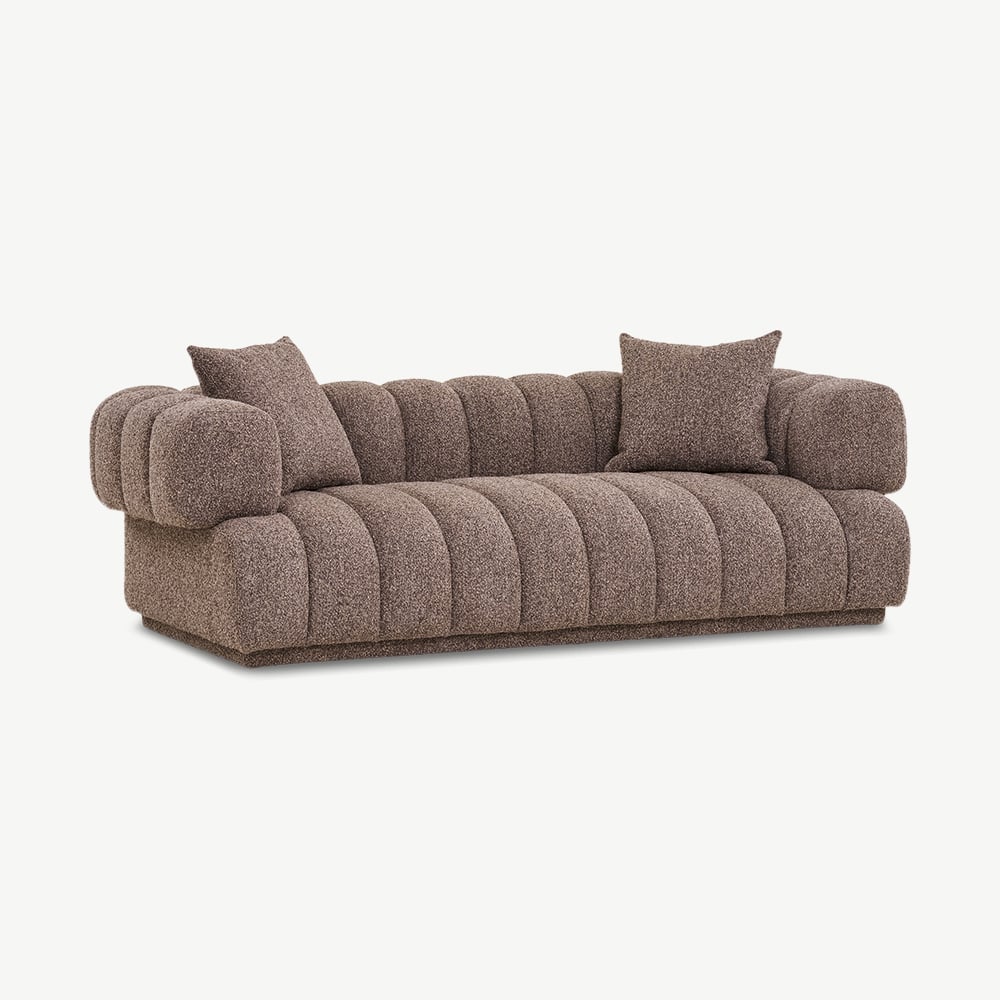
Foam density and fabric, read the spec sheet
Foam density is given in kg/m³ and is the most important number on the spec sheet for sitting quality. It does not describe how hard the foam feels (that is the indentation load deflection figure), it describes how long the foam holds its shape.
| Foam density | Realistic lifespan | Suitable for |
|---|---|---|
| Under 25 kg/m³ | 1 to 2 years | Guest rooms, occasional use |
| 25 to 30 kg/m³ | 3 to 5 years | Back cushions, light use |
| 35 to 40 kg/m³ | 8 to 12 years | Daily use, living room |
| 45 kg/m³ and above | 12 to 18 years | Heavy use, families |
For the cover, the Martindale rub count is the figure that matters. It tells you how many abrasion cycles the fabric survives before visible wear sets in. For a living-room sofa, 25,000 is the minimum, 30,000 is comfortable. Performance fabrics like our houndstooth weave reach 40,000 to 60,000 and are the right call for families with kids or pets.
For leather, three grades are worth knowing: full-grain (the top layer of hide, develops a natural patina, hard-wearing), top-grain (lightly sanded, softer to the touch), and split or bonded leather (cracks within 3 to 5 years). For the main sofa, only the first two are worth buying.
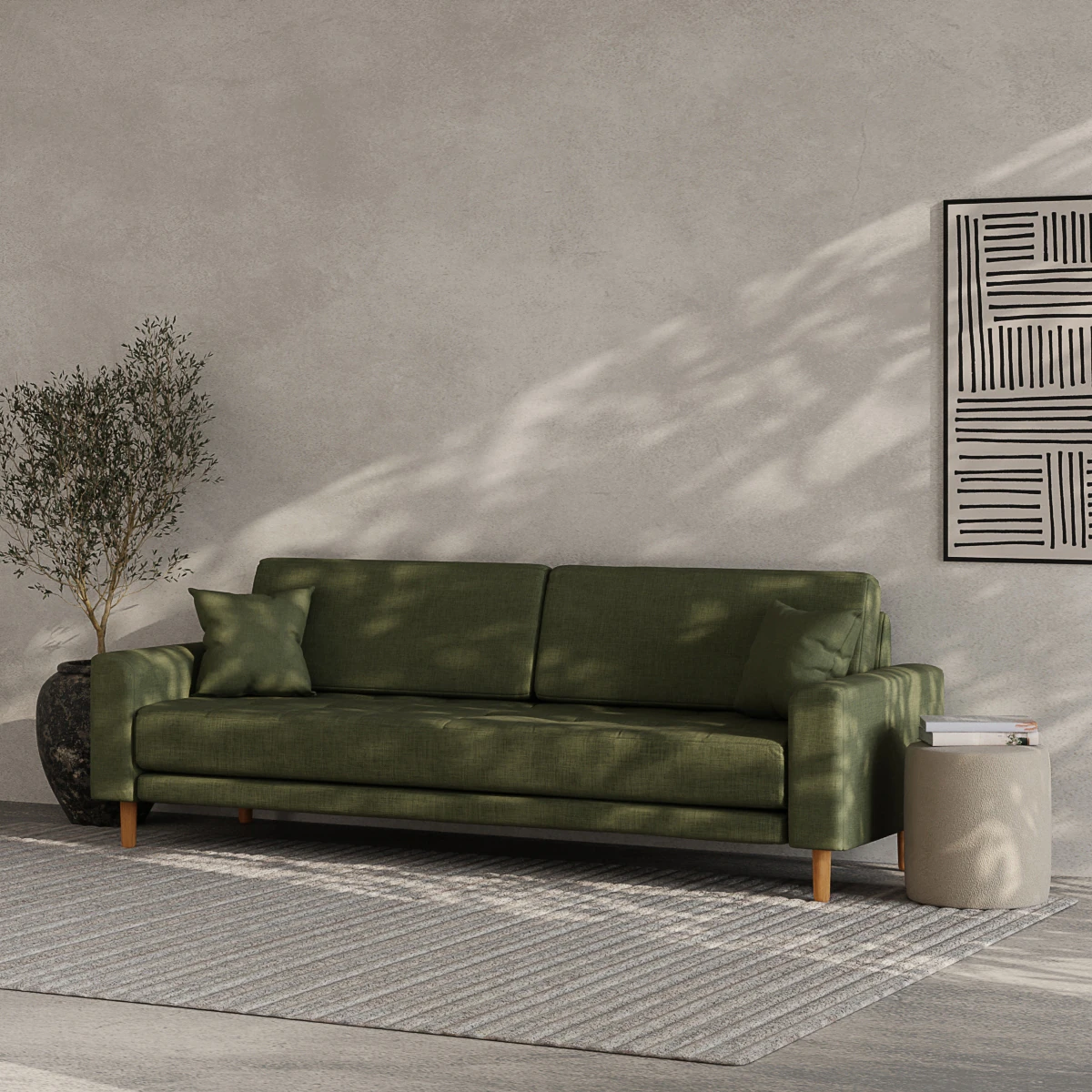
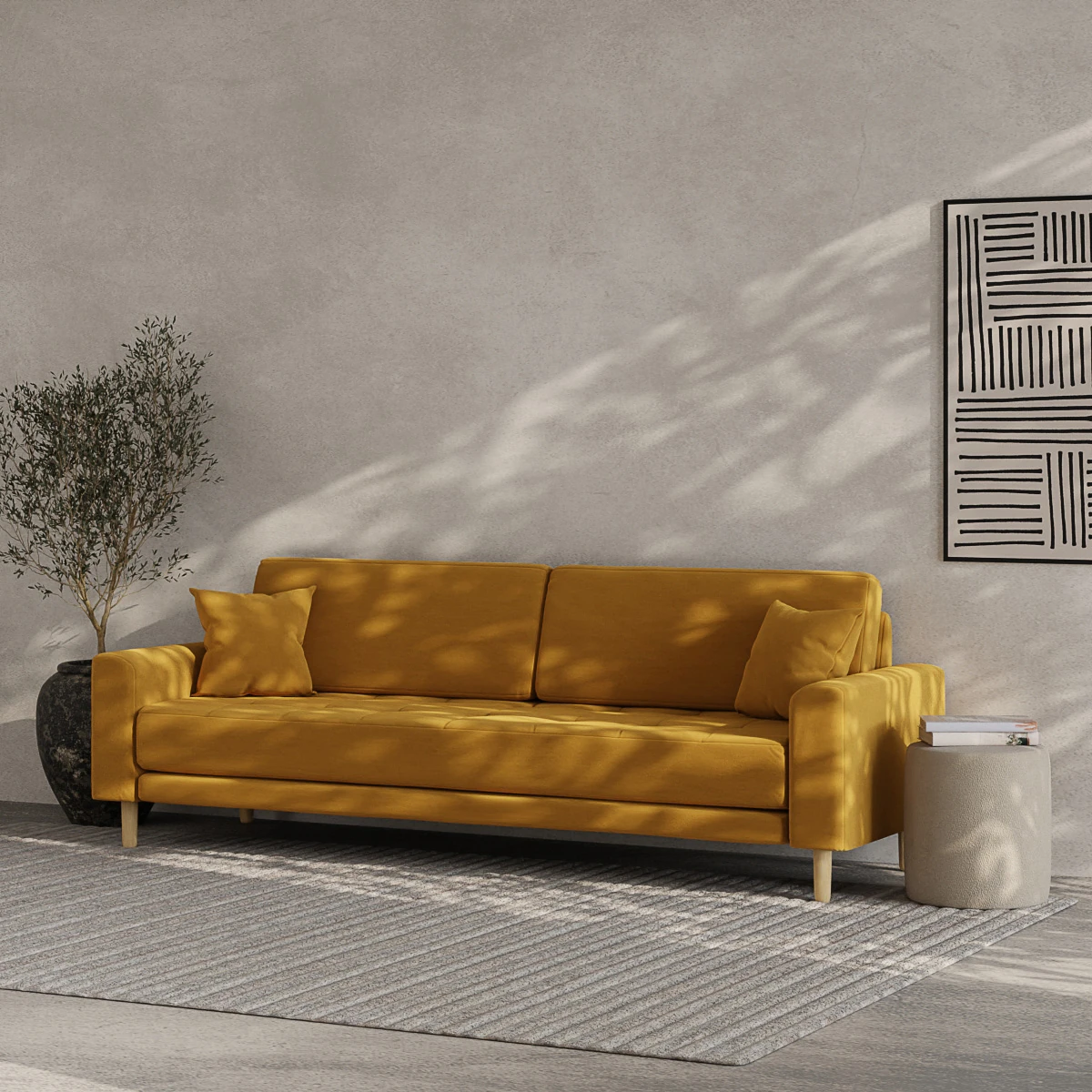
Warranty, returns, and the 15-minute sit test
Three things often skipped in the showroom that catch you out later. Settle each one before signing.
The four numbers that matter on the spec sheet
Lift width, frame material, foam density, Martindale. Get those right and the rest is taste.
You now know the figures that separate a sofa worth keeping from one that creaks after three Christmases. Our full sofa buying guide goes deeper into fabric weaves, fillings, and configurations. For corner layouts, see our corner sofa guide. For the size decision, the 2-seater versus 3-seater piece walks the trade-off.
Browse our sofa collection for models between €499 and €2,500, with hardwood-frame builds from €899. For the cover question, see our breakdown of fabric versus leather or the broader sofa materials guide.
If you lean toward Scandinavian or Japandi, our Japandi interior guide pairs linen and bouclé sofas with oak legs in a way that works in both directions.
Frequently asked.
How do I check if a sofa fits through my front door?
Measure the narrowest point of the delivery path: front door, stair turn, lift. Standard apartment lifts in Europe are often only 76 cm wide internally, and a three-seater 95 cm deep will not fit upright. If your access is tight, look at modular sofas or models with removable arms that ship in sections.
What foam density should a sofa have?
Seat cushions at 35 to 40 kg per cubic metre are the standard for daily use. At this density, the foam holds shape for 8 to 12 years before noticeable sagging. Below 30 kg/m³ the sofa sinks within 2 to 3 years. Back cushions can run at 25 to 30 kg/m³ because they take less load.
What is the Martindale rub count?
Martindale measures the abrasion resistance of an upholstery fabric in rub cycles. For a living-room sofa in daily use, look for at least 25,000 rubs, ideally 30,000 or more. Performance fabrics for families with children or pets reach 40,000 to 100,000. Below 15,000 is decorative fabric only and not suitable for upholstery.
Which frame material lasts longest?
Kiln-dried hardwood (beech, oak, ash) with mortise-and-tenon or dowel joinery is the gold standard. Look for FSC certification and a guarantee of at least 10 years on the frame. Plywood is acceptable for the seat box and corners. Full-MDF frames warp and loosen at the joints within 5 to 7 years of daily use.
How long should a quality sofa last?
A well-made fabric sofa with hardwood frame and 35 to 40 kg/m³ foam lasts 10 to 15 years before cushions need replacing or the cover starts to wear. Full-grain leather lasts 15 to 25 years with care. Bonded leather and PU often crack within 3 to 5 years; we do not recommend them for the main sitting position.
What should I check in the return policy?
Read the small print: who pays the return shipping on bulky goods? For a three-seater that can be €80 to €200. How long is the return window, and does it apply after the sofa has been assembled? At Furnicher we cover the return cost on assembled sofas for 30 days, provided the upholstery is undamaged.
