 9800+ TRUSTPILOT REVIEWS


 EN
EN DE
DE FR
FR NL
NL
A sofa is the largest purchase most people make for their living room, and it stays in daily use for a decade or more. The decisions that matter most are not the ones the showroom spotlights: not the colour, not the style name, but the frame, the foam density, and whether the lift is wide enough to get it through the door.
This guide walks through how to size a sofa for a real European living room, what frames and fillings actually last, how to compare fabric and leather honestly, and which configurations make sense for which rooms. It is the same checklist our buyers use when curating the Furnicher range.
Start with the room, not the sofa
Most sofa returns happen because the buyer measured the sofa and forgot to measure the route. Before you fall for a configuration online, walk three measurements: the doorway clearance, the lift internal dimensions, and the turn radius into the room. A standard three-seater is around 220 cm long and 95 cm deep; getting it into an Amsterdam canal-house third-floor flat is a problem the showroom does not solve.
Inside the room, plan around 90 cm of walking space in front of the sofa and 30 cm between the sofa and the nearest side wall. The coffee table sits 35 to 45 cm in front, close enough to reach without leaning forward but far enough to allow knees through.
- Doorway: 80 cm minimum for most three-seaters with arms attached
- Lift width: below 90 cm rules out many sofas; ask for modular options
- Stair turn: measure the diagonal at the landing, not the corridor width
- Floor space: add 30 cm of side clearance and 90 cm in front
What the sofa is built on
The frame is the part of the sofa you cannot see and cannot easily replace. It is also the part that determines whether the sofa lasts 5 years or 25.
Kiln-dried hardwood
Beech, oak, or ash, dried to 8 to 12% moisture content and joined with mortise-and-tenon or dowel construction. FSC certification is the standard for sustainable European sourcing. Look for guaranteed corner blocks and a frame warranty of at least 10 years.
This is what every quality sofa under 4,000 euros should be built on. Anything below that price using untreated softwood will sag within 3 years.
Engineered plywood
Multi-ply birch plywood is structurally sound for the seat box and back panel, and is often used in combination with a hardwood frame perimeter. Lighter than solid wood, which can be useful for upper-floor delivery.
Avoid sofas that use plywood for the legs or arm posts. Those points take rotational stress that plywood handles poorly over time.
MDF and softwood
MDF and untreated pine frames are common in the under-500-euro segment. They look identical in photos, hold up for the first two years, and then begin to flex at the joints. Staples replace dowels. The cushions outlive the frame.
Acceptable as a starter sofa for a rented first flat. Not a long-term purchase.
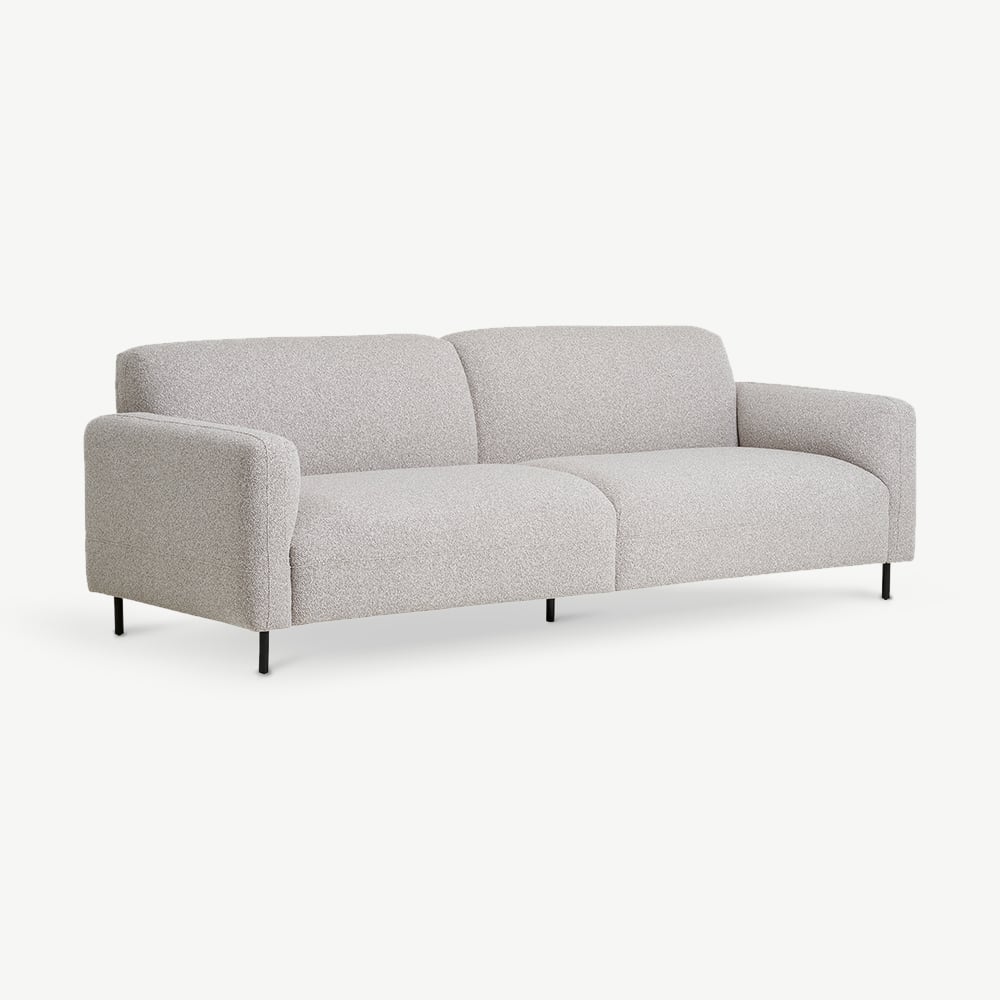
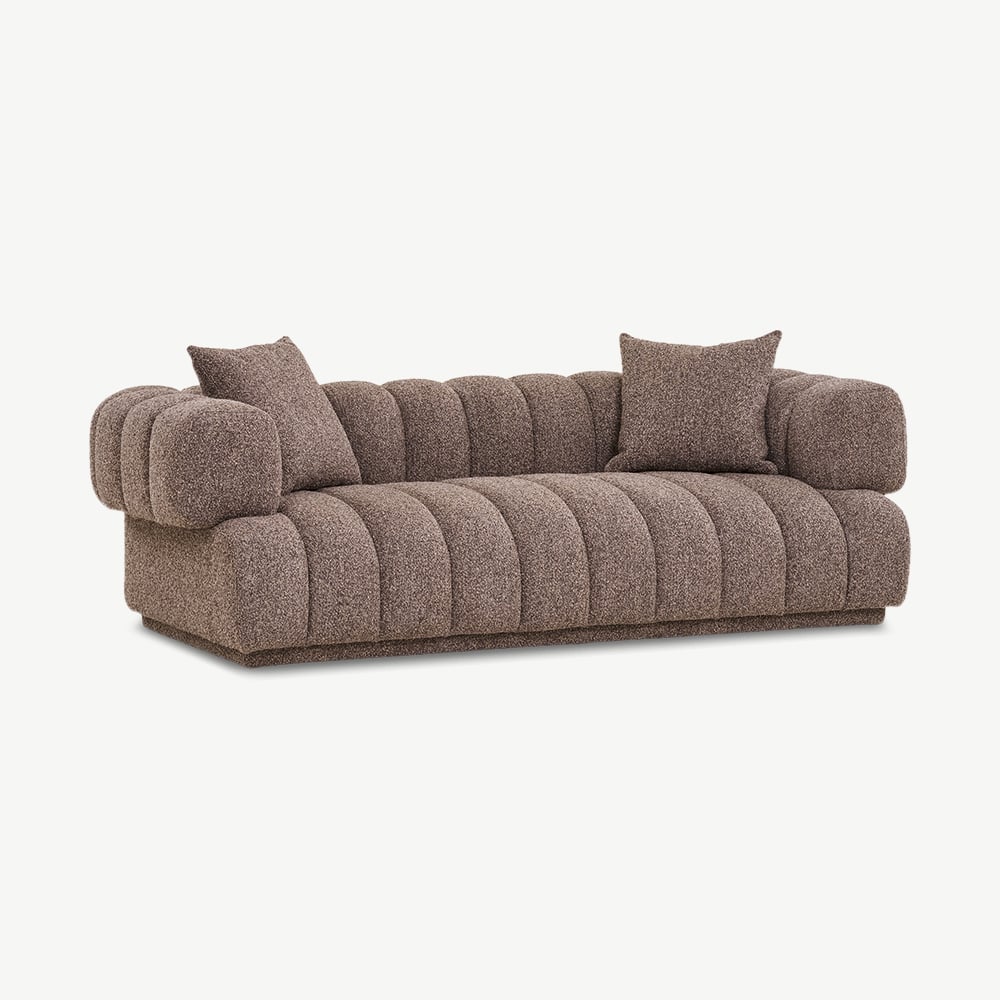
Featured in this guide


Foam density is the only seat number worth checking
Showroom comfort is misleading. A new sofa feels supportive because the foam has not been compressed yet. The number that predicts how it will feel in three years is foam density, measured in kilograms per cubic metre.
| Foam density | Feel | Lifespan before sag |
|---|---|---|
| Below 25 kg/m³ | Soft, collapses fast | 12 to 24 months |
| 25 to 30 kg/m³ | Medium-soft | 3 to 5 years |
| 30 to 35 kg/m³ | Medium-firm | 5 to 8 years |
| 35 to 40 kg/m³ | Firm, holds shape | 8 to 12 years |
| 40+ kg/m³ | Very firm | 12 to 15 years |
For the seat cushion, aim for 35 kg/m³ or higher. Back cushions can run softer (25 to 30 kg/m³) because they take less load. The premium combination is high-density foam wrapped in a feather or down layer: structural under, soft on top, plump back into shape with daily care.
Fabric, leather, and the trade-offs that come with each
The cover is the part of the sofa you live with daily. The choice depends on your household more than on style.
Performance fabrics
Tightly woven polyester or polyester-blend fabrics treated for stain release. Modern performance fabrics no longer look like outdoor furniture; many feel as soft as cotton. Look for a Martindale rub count above 30,000 for daily use.
Removable covers extend life: when one panel wears, you wash it or replace only that piece. Worth specifying at purchase.
Natural fabrics
Linen wrinkles handsomely and breathes well; boucle adds texture but attracts pet hair; cotton is soft but stains easily. Suited to households without small children or shedding pets, or when you accept that the cover will be replaced in a decade.
Light colours need professional cleaning every 2 to 3 years to keep their tone.
Leather
Full-grain leather develops a patina with use and lasts decades with light care (a conditioner twice a year, no water). Top-grain is corrected at the surface but still genuine leather. Avoid bonded leather and PU: both crack within 3 to 5 years.
Cold to sit on in winter, hot in summer. A throw or sheepskin solves both.
For a side-by-side analysis across household profiles and care routines, read our fabric vs leather sofa guide.
Two-seater, three-seater, corner, modular
Three-seaters at 200 to 230 cm seat two adults comfortably and three at a stretch; this is the standard for European living rooms above 16 sqm. Two-seaters at 150 to 180 cm work in smaller flats and as the second piece next to an armchair. Read our 2-seater vs 3-seater comparison if your room is on the smaller end.
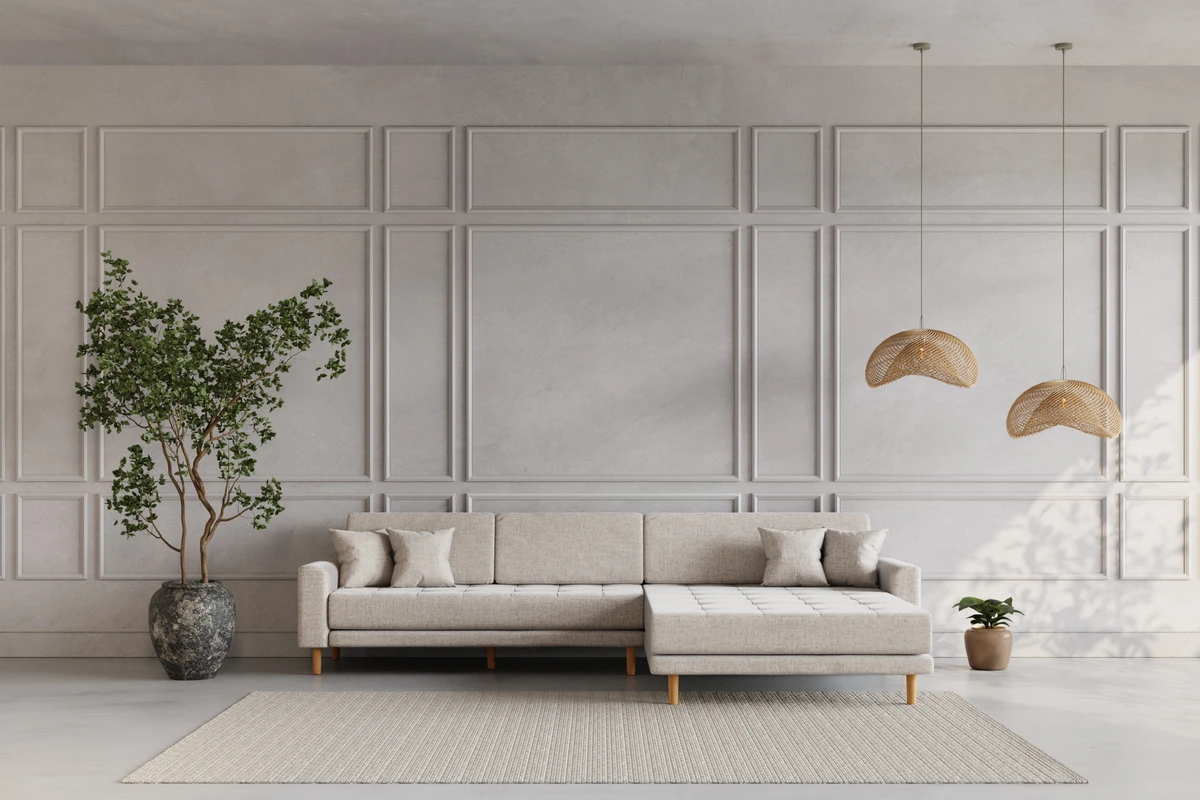
Corner sofas (L or U-shaped) add seating without taking more length than a three-seater. They lock into one orientation, so confirm whether you need a left-arm or right-arm configuration before ordering. The detailed considerations are in our corner sofa guide.
Modular sectionals consist of separate units that connect with brackets. They are the most flexible option for rooms that will be reconfigured (a child's playroom that becomes a teenager's lounge) and the easiest to deliver to flats with narrow access.
What care actually looks like
Most sofa care is preventive. The work that matters takes ten minutes a month, not a yearly deep clean.
Matching the sofa to the room
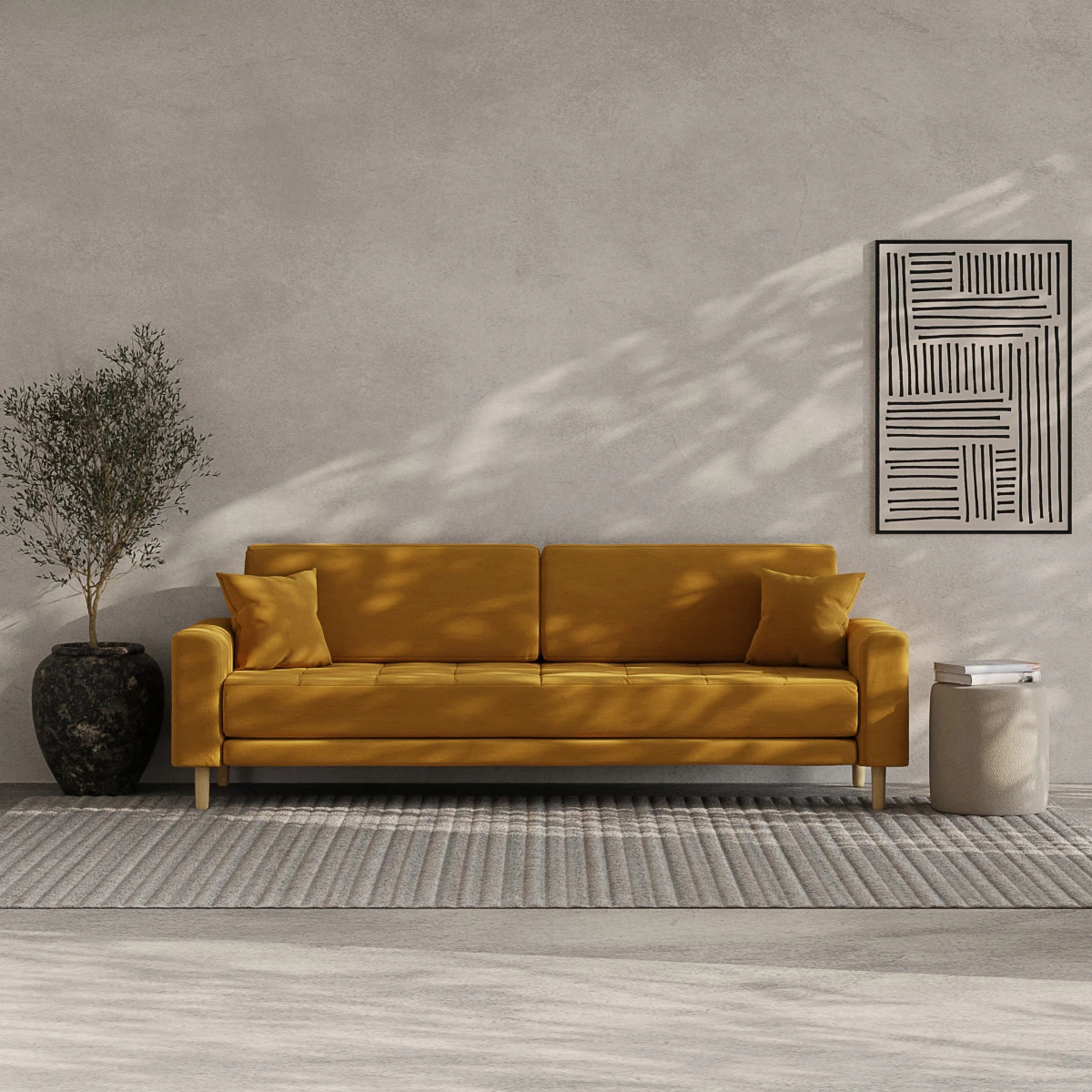
Style is the last decision, not the first. Once the size, frame, and cover are right, three directions cover most European homes.
Scandinavian
Slim profile, exposed tapered legs in oak or beech, mid-tone fabric in oat, sand, or muted green. Pairs with rugs in natural fibres and ceramic side tables. See our Scandinavian collection.
Japandi
Lower seat height (around 40 cm), wider seat depth, fabrics in clay, charcoal, and warm white. Pairs with rattan accents and low coffee tables. The Japandi collection is built around this profile.
Modern minimal
Boxier silhouette, low or no visible legs, single-colour cover usually in charcoal, mid-grey, or ivory. Reads as architectural; works well with concrete floors and large windows.
Most sofas fail on the basics, not the styling
Get the frame, foam density, and lift width right. The rest is a question of taste.
Furnicher sofas use kiln-dried beech frames with 35 to 40 kg/m³ seat foam and a 10-year frame guarantee. Removable washable covers are available on most fabric models.
Browse our sofa collection to filter by configuration, fabric, and delivery time. If you are still narrowing down, read our step-by-step sofa decision guide, the materials deep-dive, or our practical tips for buying a sofa.
Frequently asked.
What size sofa do I need for my living room?
Leave at least 90 cm of walking space in front of the sofa, and 30 cm between the sofa and any side wall. A 200 cm three-seater fits most living rooms above 16 sqm. For rooms under 14 sqm, a 160 to 180 cm two-seater plus an armchair seats the same number of people in less footprint.
What is the most durable sofa frame material?
Kiln-dried hardwood (beech, oak, ash) with mortise-and-tenon or dowel joinery is the most durable frame. Look for FSC certification and a guarantee of at least 10 years on the frame. Engineered plywood is acceptable for the seat box but full-MDF frames flex over time and rarely last past 5 to 7 years of daily use.
What foam density should a sofa have?
Seat foam at 35 to 40 kg per cubic metre lasts 8 to 12 years before it loses noticeable shape. Below 30 kg per cubic metre, the foam compresses within 2 to 3 years. Back cushions can run lower (25 to 30 kg per cubic metre) because they take less load. Feather-wrapped foam combines structure with softness but needs daily plumping.
Is fabric or leather better for a family sofa?
For families with young children, removable washable fabric covers are the easiest to maintain. For pet owners, tightly woven performance fabrics or full-grain leather both work, though leather scratches show. Velvet and boucle attract pet hair; smooth weaves and microfibres release it more easily. Light colours hide stains less than mid-tones.
How do I measure for sofa delivery?
Measure the doorway width (minimum 80 cm for a standard three-seater), the stair turn diagonal, and the lift internal width and depth. Lift width below 90 cm rules out many three-seaters. If the sofa cannot be lifted in one piece, ask whether the model is available with a removable arm or a modular configuration that ships in sections.
How long should a quality sofa last?
A well-made fabric sofa with hardwood frame and dense foam lasts 10 to 15 years before the cushions need replacing or the cover starts to wear. Leather sofas in full-grain or top-grain leather last 15 to 25 years with care. Bonded leather and PU often crack within 3 to 5 years and is best avoided for the main sitting position.
What is a sectional sofa?
A sectional is a sofa made of separate sections that connect, usually forming an L or U shape. Sectionals are useful in larger living rooms and for households where the sofa doubles as the main seating for film nights. Modular sectionals can be reconfigured; fixed sectionals come in a set orientation that must be specified as left-arm or right-arm facing.
Can I clean a sofa myself?
Removable covers go in the washing machine on a 30 degree cold cycle. Fixed-cover fabric sofas can be vacuumed weekly and spot-cleaned with a damp microfibre cloth and mild soap. For deep cleaning, hire a professional upholstery service every 2 to 3 years; expect 80 to 150 euros for a three-seater. Leather needs a conditioner twice a year and no water.
