 9800+ TRUSTPILOT REVIEWS


 EN
EN DE
DE FR
FR NL
NL
Natural rattan does not belong outdoors. That is the shortest honest sentence on the topic. Fully exposed, it lasts two to three years; under cover, eight at most. If you still want the rattan look on a terrace, the answer is poly rattan: PE weave over aluminium. That is a different material class, not a cheaper version of rattan.
This guide covers why natural rattan fails outside, how poly rattan is actually built, what lifespan to expect in different positions, and which care steps decide whether a set lasts three years or twelve.
Why natural rattan dies outside
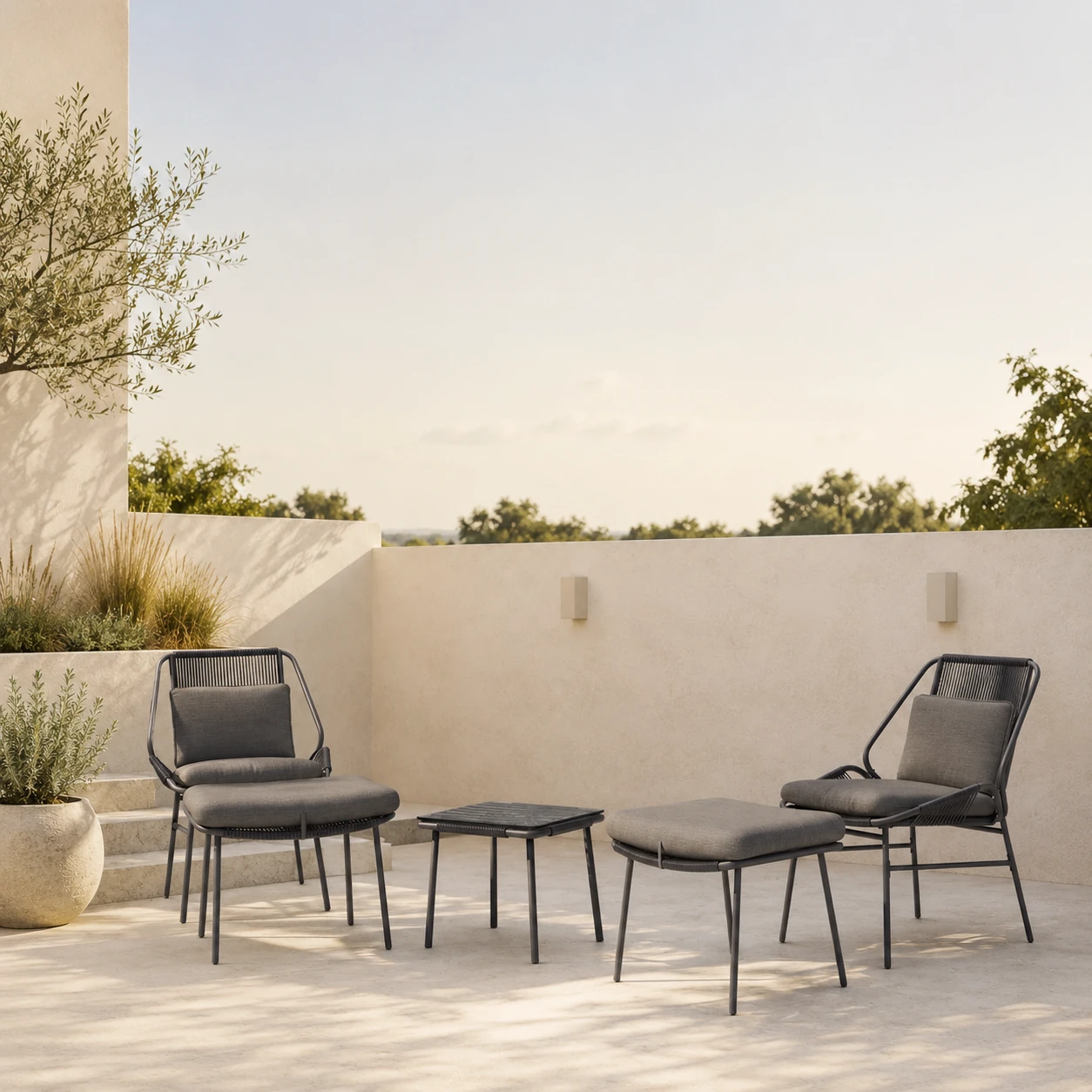
Rattan is hygroscopic: the fibre absorbs and releases moisture as humidity changes. Indoors, humidity sits between 35 and 55 percent, which rattan tolerates easily. Outside, humidity swings from 90 percent at night to 40 percent at midday. Those cycles swell and shrink the fibres until the weave loosens and the poles split where they were drilled for joinery.
Three other failures stack on top. UV strips the lignin layer that gives rattan its colour, turning it grey within one season. Frost expands water trapped in the fibres and splits the wrapping at joints. Mould finds permanent conditions in knots that never fully dry. One soaked night is recoverable. Four weeks of weather is permanent damage.
- Humidity cycling: swells and shrinks the fibres, loosens the weave
- UV: grey-out within one season
- Frost: trapped water expands, joinery splits
- Mould: nearly inevitable in damp knots
What works instead
Three materials cover most "rattan-look" outdoor furniture. The differences are large; price alone does not tell you which is which.
PE rattan on aluminium
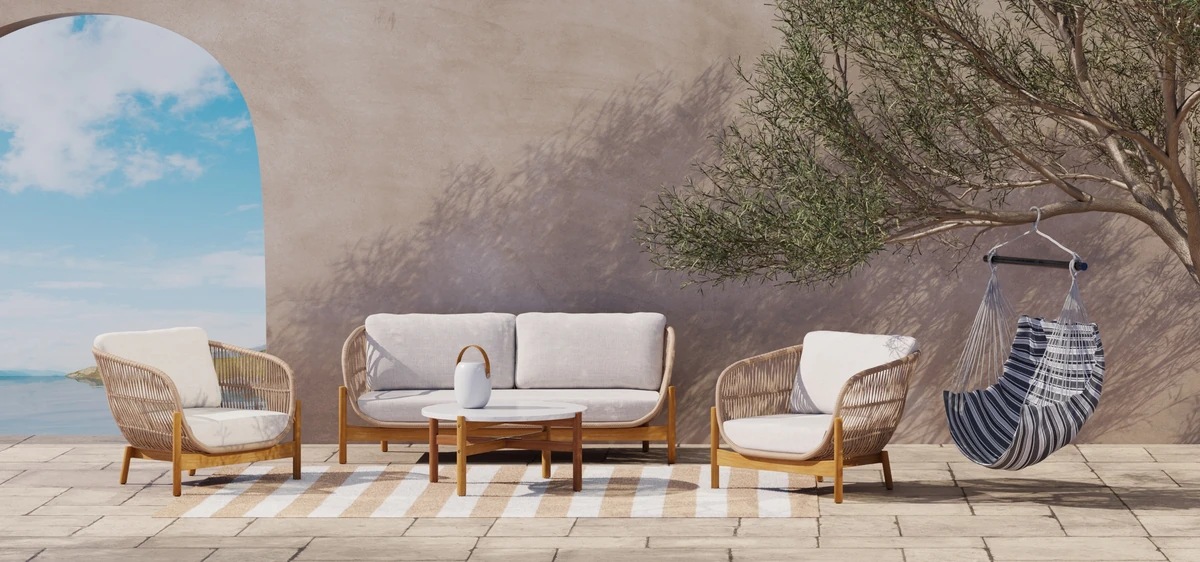
Polyethylene strands woven over a powder-coated aluminium frame. UV-stable per ISO 4892-2 (2,000 hours standard, 5,000 hours premium), frost-proof to minus 30 Celsius, water-resistant. Identify by uniform colour and a slightly waxy surface.
The right pick for any uncovered terrace, balcony or garden where the set stays out all year. Skip the cheaper steel-framed lookalike if your patio sees salt air or coastal damp.
PE rattan on steel
Same weave, but on a steel frame with powder coating against rust. Once the coating chips at a stress point, the steel rusts through in 2 years, often before the weave shows wear.
Identify by weight (noticeably heavier than aluminium) and the dull sound when you tap the frame.
PVC or paper weave
Brittle PVC or coated paper weave, usually on chipboard or thin steel. Sold in discount sets labelled "rattan" or "poly rattan". Crumbles under UV within a season; breaks in the first frost.
Rule of thumb: a four-seat set under €200 almost always falls in this category.
Featured in this guide



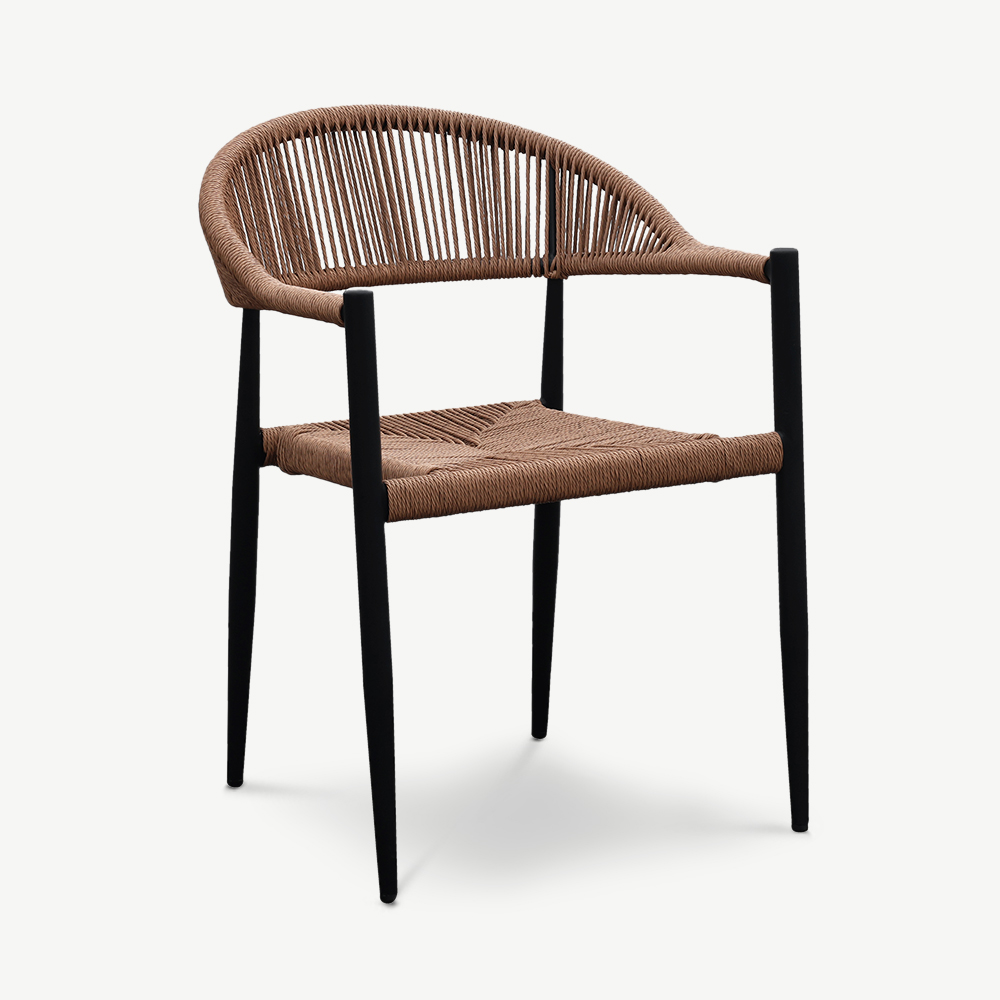
How long rattan furniture really lasts outdoors
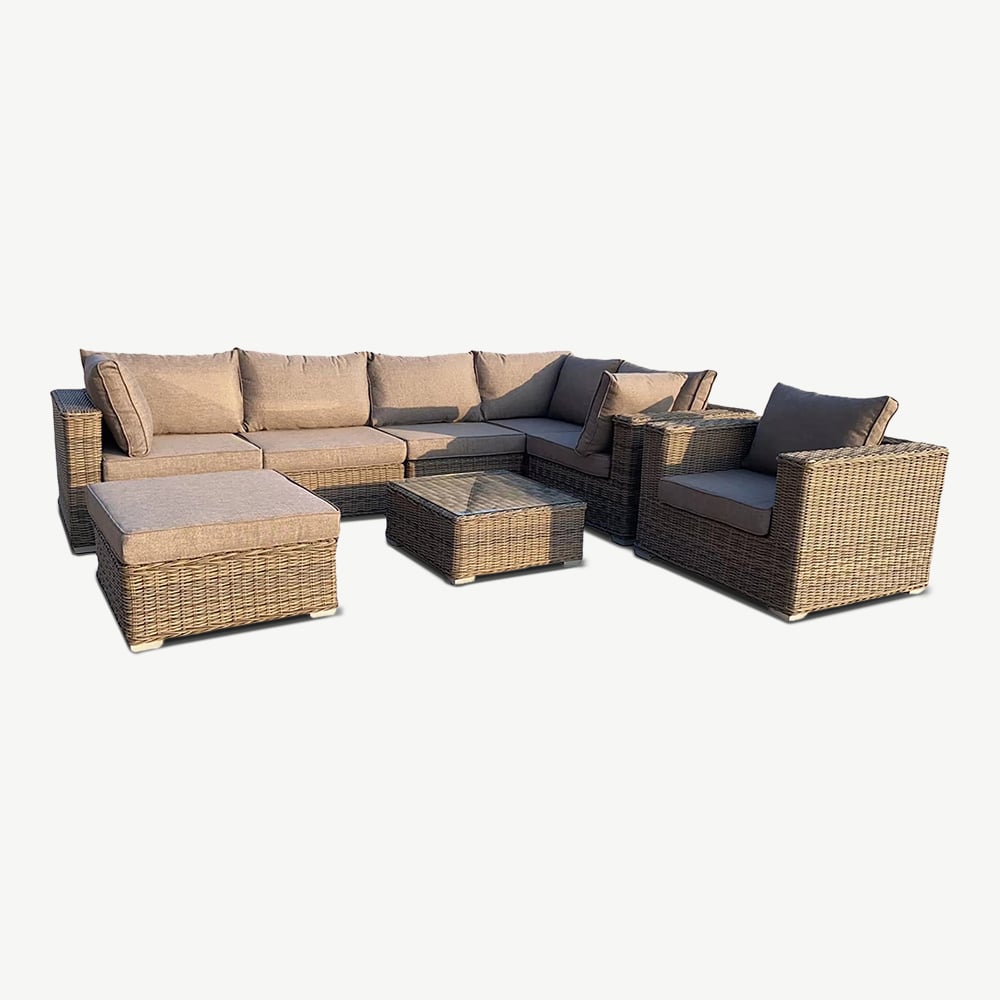
This table builds on the data in our rattan chair guide and extends it into outdoor scenarios. Figures are from 200,000 pieces sold and five years of warranty data.
| Position | Natural rattan | PE on aluminium |
|---|---|---|
| Indoors, temperate | 15 to 25 years | 10 to 15 years |
| Covered terrace, dry climate | 5 to 8 years | 12 to 18 years |
| Covered terrace, damp climate | 3 to 5 years | 10 to 15 years |
| Fully exposed | 2 to 3 years | 8 to 12 years |
| Fully exposed, no winter cover | 1 to 2 years | 6 to 10 years |
These lifespans assume minimum care: rinse twice a year, store cushions dry, cover or store the set over winter. With zero care, the PE figure drops to the lower end of the range; natural rattan outside without care fails inside one season.
Four steps that double the lifespan
Poly rattan is far lower maintenance than solid-wood outdoor furniture, but not maintenance-free. These four steps roughly double average service life.
What actually works outside
PE rattan on aluminium, with basic care. Nothing else.
Natural rattan on a terrace is an emotional decision, not an economic one. You are paying for a piece you replace in two or three years. PE rattan on aluminium costs similar money, lasts three to four times longer and looks the same in its second summer as in its first. On total cost per year of use, the choice is not close.
Browse our outdoor furniture selection. Poly rattan sets start at €380 for a four-seat group; premium sets sit between €750 and €1,450. For the indoor side of the catalogue, see our rattan furniture guide.
If you are buying rattan across categories, our article on buying rattan furniture helps with category-by-category positioning. For a calmer interior pairing, our Japandi furniture collection shows the look indoors.
Frequently asked.
Can natural rattan be used outdoors?
Not permanently. Fully exposed natural rattan lasts 2 to 3 years; under a covered terrace, 5 to 8 years in a dry climate. Rain, UV and frost destroy the fibres: the weave loosens, knots mould, and the poles split at the drill holes used for joinery. For any outdoor use, choose synthetic PE rattan over a powder-coated aluminium frame instead.
What is poly rattan and why is it different?
Poly rattan is polyethylene (PE) extruded into strands and woven over a powder-coated aluminium frame. It looks like natural rattan but is UV-stable, frost-proof and water-resistant. Quality poly rattan carries a UV rating per ISO 4892-2: 2,000 hours is the basic threshold for outdoor use, 5,000 hours indicates premium quality with longer colour retention.
How long does poly rattan last outdoors?
On a solid aluminium frame, PE rattan lasts 8 to 12 years fully exposed and up to 18 years in a covered outdoor position. On cheap steel framing, the chair structure rusts through in 3 to 5 years, long before the weave fails. The frame material decides total lifespan more than the weave quality alone, so check what is under the plastic before buying.
Does poly rattan need to be stored over winter?
Quality PE rattan is frost-proof down to minus 30 Celsius, so storage is not strictly required. We still recommend a breathable cover or basement storage because dirt and algae settle into the weave during damp winter months. Cushions and seat pads must be stored dry regardless; they are not waterproof and they breed mould under tarps.
Does natural rattan work on a covered terrace?
In dry climates, partially. A properly covered terrace without driving rain, in dry continental air, extends life to 5 to 8 years. In damp climates (northern Germany, the Netherlands, the British Isles, Brittany), even covered air carries enough humidity year-round for mould to take hold. Natural rattan there is not worth it, even under cover.
